End of year message from YAN’s CEO Davit Satyan

It’s the last day of the year and I wanted to talk about the ambitious plans we have for YAN in 2022 and the years coming. It’s quite certain that we’re at a crossroads where banks clearly need to take the lead in driving innovation as there won’t be much room to catch up for them later unless they quickly rethink their offerings now. We at YAN see this as a business opportunity, so we strive soon to be among the top innovative banks to ensure that we deliver valuable and sophisticated financial products to our well-versed clients.

As the amount of data companies now deal with is huge, in response we see the proliferation of platforms across the industries, each of which will eventually evolve into an autonomous ecosystem of TPPs connected via APIs. This is inevitable for any structure that, once large enough, must eventually consolidate itself to scale up beyond its pre-agreed scopes. It was a concept that I explored from the outset that prompted me to realize that the potential economic growth for financial service providers can happen if they rethink their business model through Platformification. Since its inception in 2020, YAN has pursued this very idea by developing its Super App and other tech infrastructure soon to be disclosed, and our conviction that we are on the right track has been further reinforced by the processes going on with Open Banking and PSD2. YAN will grow into an open, cross-industry ecosystem as our goal is to become a major technology hub for highly skilled engineers developing more sophisticated financial and e-commerce products for both personal and business customers.

We are committed to a quick implementation of our roadmap as we look forward to announcing YAN’s first investment round next year. 2021 was a blockbuster year as we saw significant growth in venture investments across many verticals. This investment trend will continue to set new records in 2022, according to many analysts, as investors are likely to double down on traditionally key sectors such as financial services, fintech, and e-commerce. All this promises to be an exciting year for YAN as well, as we have a pre-launch scheduled for March 2022 in two cornerstone jurisdictions such as the US and UK, where we will be registering our first Sellers – YAN business bank account holders, to three of our business subscription plans.

In this light, first I want to thank everyone who has supported us so far on this rather difficult but extremely interesting startup journey, and wish all our colleagues, partners, and each one of you here on LinkedIn and elsewhere, a wonderful, rewarding and financially prosperous year! Your sawed seeds of dedication, hard work and commitment will eventually let you enjoy the fruits of happiness and success, never hesitate! Happy New Year 2022! 

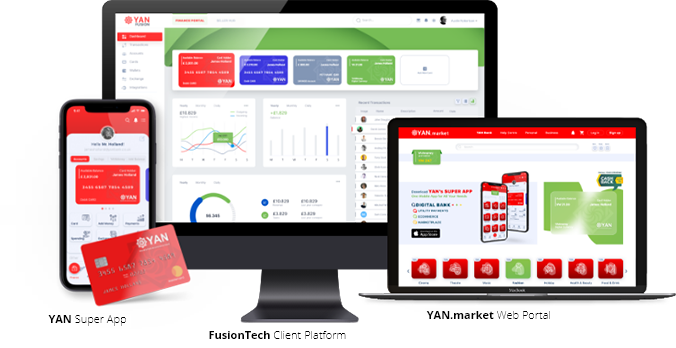
YAN’s Super App from scratch

It was surely a long but interesting journey for YAN’s team of developers who worked hard for about a year and now continue to optimize and ensure high quality software is coded for their startup in a quite tight timeline. It was initially decided that YAN should be a full-stack platform able to control the entire chain and not be dependent on third party technologies.This approach can be called the cornerstone of the company’s philosophy, as it needed more control and flexibility to meet the needs of customers today and in the future.

YAN’s technological team includes web designers, security specialists, Java and PHP developers, system developers and maintenance specialists working on building from the ground up YAN’s software environment with so far 12344 files and more than 8 million lines of code.

YAN is building from the ground up its multi-industry Super App software which to date contains 12344 files and more than 8 million lines of code.

You will probably be interested to know more on specifics of YAN’s hardware infrastructure which is divided into 3 main environments: 1) Development environment  2) Test environment and 3) Production environment. Development Environment operates on 2 servers (Api/backend server and Authentication server) where engineers develop the software required for company services (backend, authorization server, transaction server). When the software is ready, it then goes through the test environment. 

The Test Environment is located on 2 servers (Api/backend server and Authentication server). Here we test the software developed in a sandbox environment. We can test all functions and check software vulnerabilities and their potential bugs. When the software passes all the programmed tests, it is then loaded into the production environment with its 4 servers.

  1. Authentication Server is required to authenticate customers and internal staff who enter and use our cloud. The system is a bank-grade authentication server with single sign-on (SSO) capability – it’s a session and user authentication service that permits a user to use one set of login credentials, e.g. a name and password, to access multiple applications. As our business grows, we will move this server to an authentication cluster. 
  1. API server – this is for connecting mobile Apps to all possible operations (banking, cards, e-commerce, marketplace, etc.). As our business grows, we will migrate it to the backend cluster. 
  1. Backend server is used to manage the entire infrastructure (users, transactions, settings, logs, etc.). This server is the core of the infrastructure and will be later moved to a dual geographic cluster to avoid possible downtime. 
  1. Database server is used to run a database engine and to decouple the database server from the Internet. This server is located on internal networks and is not accessible from outside our cloud. In the future, it needs to be moved to the database cluster. 

We hope this has shed some more light on what YAN’s engineers have been continuously working on over the past year but we will be back with more news, including about our technologies that help to create a risk profile or score, providing external data points related to finance, lifestyle, social and health.

Follow our updates and stay tuned!


Tech enabling happy customers

Over the last 10 years, banks have faced the fallout from the global financial crisis, regulatory reforms, the birth of new competitors, and now a global pandemic. The speed that modern technology has developed has meant that the traditionally slow-moving financial institutions have had to invest billions to remain relevant to customers, and competitive in the marketplace.

Old fashioned banks, no thanks.
Customers’ lifestyle habits are increasingly motivated and directed by the speed and simplicity of online services; the same is true of how they want to bank.

Customers expect convenience, security, and personalisation – and that demands a far more agile, personal approach to banking. Consumers’ growing desire to access financial services from digital channels has led to a surge in new banking technologies that are reconceptualizing the entire retail banking market.

Better customer service? Then tech is essential…

Perhaps the biggest way that FinTech is disrupting the finance and banking sector is through customer service. Remember when banking was tiring and slow… you had to stand in lots of queues, file lots of paperwork and be physically present!

In a recent Qualtrics survey (*1) of more than 550 banking customers, poor service and poor financial advice emerged as top reasons why people leave their banks. 

69% of customers surveyed listed poor services as the primary reason for leaving, with 56% indicating the bank could have changed their mind if any attempt had been made to salvage the relationship.

What are the tech options available to support better customer service?

Self Service
Despite it being a clear competitive differentiation, the financial services industry has been slower than others to implement self-service capabilities and best practices. As a result, many institutions are missing out on valuable opportunities to reduce call centre volume, provide 24/7 support, and improve overall customer service in banking.

Consumer self-service has become a growing trend, with 74% of customers reporting that they have used a self-service support portal in the past; another 81% reported that they’ve attempted to resolve issues on their own before contacting a live service representative. (*2)

Be contactable. Whenever the customers wants.

Live Chat
Customers expect timely and flexible support. Through virtual banking, you can offer a live chat conversation, which can be transformed into a video chat in mere seconds by clicking a URL provided by a consultant. When no advisor is available, customers can use a chatbot to find answers for many typical questions quickly.

Chatbots
Chatbots are rapidly become the norm for customers to interact with. AI enabled chatbots can help customers with a variety of tasks from engaging to interacting with customers 24/7 – breaking down the idea of traditional banking hours. Customers are becoming increasingly comfortable conversing with chatbots for a variety of things making this a logical next step for the bank to invest in. 

Artificial Intelligence (AI)
The financial customer experience of the future will be significantly affected by AI. This will be most notable through the delivery of mass personalisation and assisting customers as they overcome low levels of financial literacy.

AI is today being used for the daily challenges faced by many businesses like CX, loyalty building, anomaly detection and fraud prevention. Here are some scenarios for AI use cases in banking: Location intelligence, Query routing, Biometric authentication, Natural language generation (NLG), Behavioural biometrics, ID verification, KYC and AML, Sentiment analysis, Customer lifetime value modelling and Call centre agent matching

Technology is the enabler that makes it easier and frictionless for the customer which in turn creates substantial competitive advantage. Yan Bank are challenging the universal banking model with their lower costs, personalized insights, predictive intelligence, user-friendly interfaces, easy accessibility, and simplified processes. Through tapping into digital ecosystems and smart technology, YAN are building an accessible Fusion Bank.

References

(*1) Hitachi Solutions https://global.hitachi-solutions.com/blog/how-to-improve-customer-service-in-banks

(*2) http://info.microsoft.com/rs/157-GQE-382/images/EN-CNTNT-Report-DynService-2017-global-state-customer-service-en-au.pdf